
Barbell Power Jerk
The Barbell Power Jerk is a compound movement that trains the quadriceps with help from adductors, front delts, side delts, calves, glutes, hamstrings, chest and triceps. This guide covers the setup, the execution, the mistakes worth fixing early, and how to program it.
This is conditioning work: continuous effort that raises your heart rate, builds work capacity and burns meaningful calories, with the quadriceps driving the movement. It complements lifting rather than replacing it.
Who it is for. Anyone building fitness or supporting a fat-loss phase. Put it after lifting, or on a separate day, so it does not blunt your strength work.
Muscles worked
The prime mover here is the quadriceps, with adductors, front delts, side delts, calves, glutes, hamstrings, chest and triceps assisting — which is why this movement earns its place as more than a single-muscle exercise.
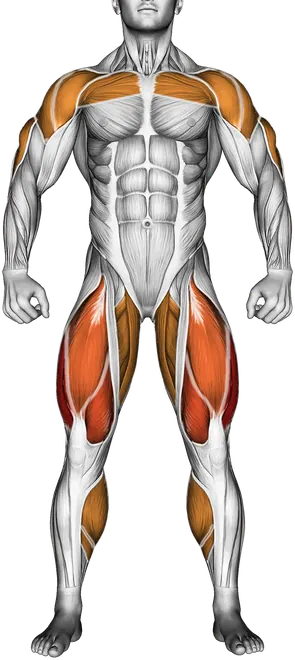 Front
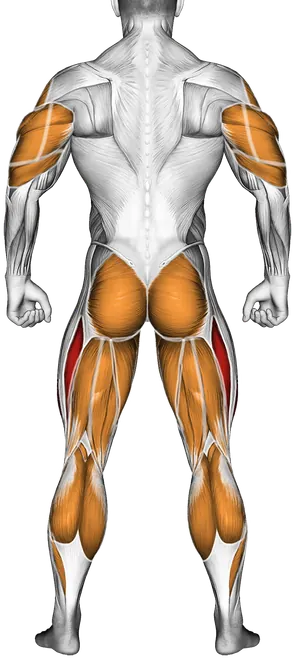 Back
- Vastus lateralis100%
- Vastus medialis80%
- Rectus femoris70%
- Upper chest50%
- Front delts50%
- Side delts50%
- Triceps long head50%
- Gluteus maximus50%
- Adductors50%
How to do it
- Clear the space you need and set up a barbell before you start the clock.
- Warm up for a few minutes so the first interval is not the warm-up.
- Decide on the work and rest periods before you begin, rather than going until you are wrecked.
- Move at a pace you can repeat — the aim is a sustainable effort, not one heroic round.
- Keep your technique sharp as you tire; sloppy reps under fatigue are where injuries come from.
- Finish the last interval feeling like you could have done one more.
Breathing. Breathe rhythmically and through the nose where you can. Match your breath to the movement rather than holding it.
Form cues that matter
- Pick a pace you can hold for every round.
- Breathe rhythmically rather than gasping.
- Stop the set when technique degrades.
- Going flat out on the first round and fading
- Letting form fall apart as fatigue builds
Common mistakes
| The mistake | Do this instead |
|---|---|
| Going flat out on the first round and fading | Start a notch below what feels possible and hold it. |
| Letting form fall apart as fatigue builds | Cut the interval short; conditioning is not a reason to move badly. |
| Doing so much it eats into your lifting recovery | Keep hard conditioning to two or three sessions a week alongside a lifting program. |
What makes this variation different
The Barbell Power Jerk is a specific version of this movement, and the details in its name change how it should be performed.
- A barbell lets you load more weight than anything else and add it in small increments, which makes it the best tool for long-term strength progress. It also forces both sides to work together, so a stronger side can cover for a weaker one.
Sets, reps and rest
| Goal | Sets | Reps | Rest |
|---|---|---|---|
| Strength | 3-5 | 20-40 s hard | 30-90 s |
| Muscle growth | 3-4 | 30-60 s | 30-90 s |
| Endurance | 2-3 | 2-20 min | 30-90 s |
How to progress
Add time or difficulty rather than load. Once you can hold the position cleanly for the top of the range, progress to a harder variation or add external resistance instead of simply holding longer.
Variations and alternatives
If you do not have the equipment, or you simply want to rotate the stimulus, these 8 movements train the quadriceps in a similar way.
- Alternate Punching — Bodyweight
- Arm Raise Step in Place — Bodyweight
- Bodyweight Skipping — Bodyweight
- Briskly Walking — Bodyweight
- Burpee — Bodyweight
- Butt Kicks — Bodyweight
- Celebratory Knee Drives — Bodyweight
- Diagonal Punch — Bodyweight
Safety
Key takeaways
- Pick a pace you can hold for every round.
- Breathe rhythmically rather than gasping.
- Work in the 30-60 s rep range for muscle growth, leaving a rep or two in reserve on most sets.
- Full range of motion on the Barbell Power Jerk matters more than the weight on it.
- Progress gradually and keep technique identical as the load goes up.
Go deeper
FAQ
What muscles does the Barbell Power Jerk work?
It works the quadriceps as the prime mover, with adductors, front delts, side delts, calves, glutes, hamstrings, chest and triceps assisting. The midsection also works throughout to keep you stable.
How many sets and reps should I do on the Barbell Power Jerk?
Three to four working sets of 30-60 s reps suits most people training for muscle growth, leaving one or two reps in reserve. Across all the exercises that train this muscle, - hard sets a week is a productive range.
Is the Barbell Power Jerk good for beginners?
Yes, provided you start light enough to own the technique. Spend the first few weeks on the movement itself with a load you could do several more reps with, and add weight only once the pattern is automatic.
What can I do instead of the Barbell Power Jerk?
Alternate Punching, Arm Raise Step in Place and Bodyweight Skipping all train the quadriceps in a similar way, so any of them works as a substitute when the equipment is taken or you want to rotate the stimulus.
What equipment do I need for the Barbell Power Jerk?
This version uses a barbell. The pattern matters more than the tool, though — the alternatives above cover the same movement with whatever you have available.
Track your sets, reps and progress on the Barbell Power Jerk — free, with every exercise in the library.