
Dumbbell Squeeze Bench Press
The Dumbbell Squeeze Bench Press is a compound movement that trains the chest with help from triceps and front delts. This guide covers the setup, the execution, the mistakes worth fixing early, and how to program it.
Pressing a load away from your torso is the foundation of upper-body pushing strength, and it trains the chest alongside triceps and front delts in one movement. It is the lift most people measure their pressing strength by, and the one where small setup details make the biggest difference.
Who it is for. Everyone, from the first session onward. It goes first in a push or upper-body day, while you can still generate force.
Muscles worked
The prime mover here is the chest, with triceps and front delts assisting — which is why this movement earns its place as more than a single-muscle exercise.
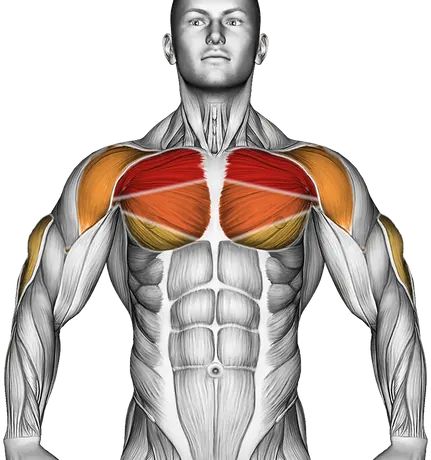 Front
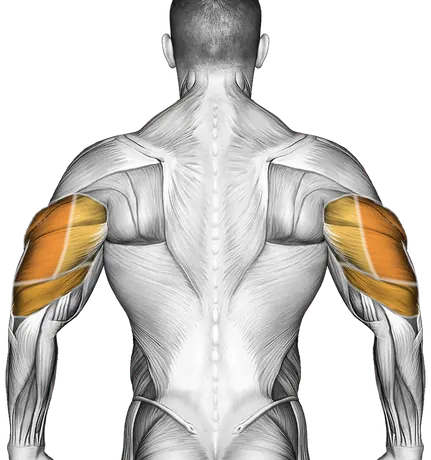 Back
- Upper chest100%
- Middle chest70%
- Lower chest30%
- Front delts50%
- Triceps lateral head50%
- Triceps medial head39%
- Triceps long head22%
How to do it
- Set your shoulder blades down and back into the bench or floor and keep them there — a stable base is what lets you press heavy safely.
- Take a dumbbell with your wrists stacked straight over your elbows, not bent back.
- Plant your feet and create tension through your whole body before the first rep.
- Lower under control to your chest, keeping your elbows at roughly 45 to 75 degrees from your torso rather than flared straight out.
- Touch or come close to the chest without bouncing, then press back up and slightly back toward your shoulders.
- Finish with your arms nearly locked, keeping the shoulder blades pinned down throughout.
Breathing. Breathe in and brace at the top, hold through the descent and press, and breathe out once you are past the hardest point.
Form cues that matter
- Shoulder blades stay back and down for the whole set.
- Elbows tucked to around 45 degrees, not flared to 90.
- Press yourself away from the load, not the load away from you.
- Flaring the elbows straight out to the sides
- Bouncing the load off the chest
Common mistakes
| The mistake | Do this instead |
|---|---|
| Flaring the elbows straight out to the sides | Tuck them closer to your body; it protects the shoulder and usually adds weight to the bar. |
| Bouncing the load off the chest | Pause briefly at the bottom of every rep and press from a dead stop. |
| Letting the shoulders roll forward at the top | Keep the blades pulled back and stop just short of a hard lockout. |
What makes this variation different
The Dumbbell Squeeze Bench Press is a specific version of this movement, and the details in its name change how it should be performed.
- Dumbbells let each side work independently, which exposes and fixes imbalances, and they allow a more natural path than a fixed bar. Expect to use less total weight than the barbell version.
Sets, reps and rest
| Goal | Sets | Reps | Rest |
|---|---|---|---|
| Strength | 3-5 | 3-6 | 2-3 min |
| Muscle growth | 3-4 | 6-12 | 2-3 min |
| Endurance | 2-3 | 12-20 | 2-3 min |
- 10-20Weekly sets
- 2-1-1Tempo
- 2-3 minRest
How to progress
Add weight before you add reps. Work at the top of your rep range for two sessions in a row with clean technique, then put the smallest increment available on the Dumbbell Squeeze Bench Press and build back up. Small, boring jumps beat big ones.
Variations and alternatives
If you do not have the equipment, or you simply want to rotate the stimulus, these 8 movements train the chest in a similar way.
- Barbell Bench Press — Barbell
- Dumbbell Bench Press — Dumbbell
- Barbell Incline Bench Press — Barbell
- Dumbbell Incline Bench Press — Dumbbell
- Lever Chest Press — Machine
- Chest Dip — Bodyweight
- Push-Up — Bodyweight
- Barbell Close Grip Bench Press — Barbell
Safety
Key takeaways
- Shoulder blades stay back and down for the whole set.
- Elbows tucked to around 45 degrees, not flared to 90.
- Work in the 6-12 rep range for muscle growth, leaving a rep or two in reserve on most sets.
- Full range of motion on the Dumbbell Squeeze Bench Press matters more than the weight on it.
- Progress gradually and keep technique identical as the load goes up.
Go deeper
FAQ
What muscles does the Dumbbell Squeeze Bench Press work?
It works the chest as the prime mover, with triceps and front delts assisting. The midsection also works throughout to keep you stable.
How many sets and reps should I do on the Dumbbell Squeeze Bench Press?
Three to four working sets of 6-12 reps suits most people training for muscle growth, leaving one or two reps in reserve. Across all the exercises that train this muscle, 10-20 hard sets a week is a productive range.
Is the Dumbbell Squeeze Bench Press good for beginners?
Yes, provided you start light enough to own the technique. Spend the first few weeks on the movement itself with a load you could do several more reps with, and add weight only once the pattern is automatic.
What can I do instead of the Dumbbell Squeeze Bench Press?
Barbell Bench Press, Dumbbell Bench Press and Barbell Incline Bench Press all train the chest in a similar way, so any of them works as a substitute when the equipment is taken or you want to rotate the stimulus.
What equipment do I need for the Dumbbell Squeeze Bench Press?
This version uses a dumbbell. The pattern matters more than the tool, though — the alternatives above cover the same movement with whatever you have available.
Track your sets, reps and progress on the Dumbbell Squeeze Bench Press — free, with every exercise in the library.