
Lever Seated Dip
The Lever Seated Dip is a compound movement that trains the triceps with help from front delts, lats, neck and chest. This guide covers the setup, the execution, the mistakes worth fixing early, and how to program it.
Straightening the elbow against resistance trains the triceps, which makes up about two thirds of your upper arm. The one rule that matters is that the upper arm stays fixed — the moment the shoulder starts helping, the triceps stop being the limit.
Who it is for. Anyone building arms or pressing strength. Program it after your compound pressing.
Muscles worked
The prime mover here is the triceps, with front delts, lats, neck and chest assisting — which is why this movement earns its place as more than a single-muscle exercise.
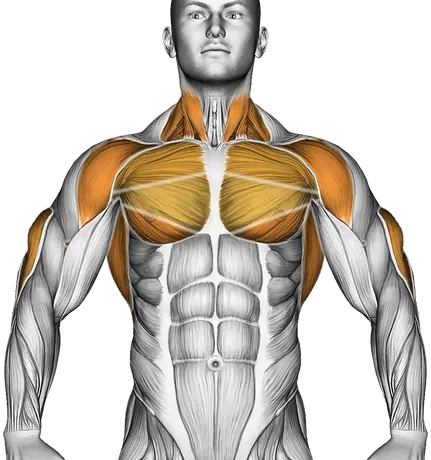 Front
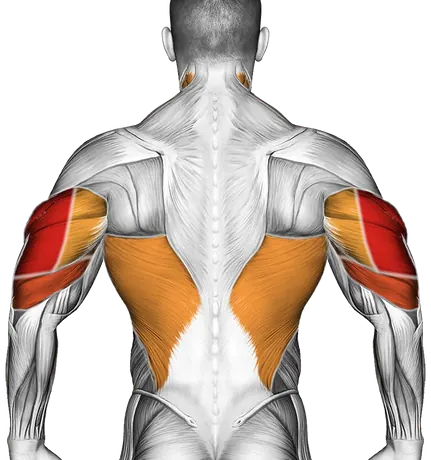 Back
- Triceps lateral head100%
- Triceps medial head78%
- Triceps long head44%
- Lower chest50%
- Front delts50%
- Latissimus50%
- Neck50%
- Upper chest38%
- Middle chest26%
How to do it
- Set up with a machine and fix your upper arms in position — by your sides, overhead, or against a pad, depending on the movement.
- Brace your midsection and set your torso at an angle you can hold for the whole set.
- Take the slack out of the resistance before the first rep.
- Extend your elbows fully, moving only the forearms.
- Squeeze the triceps at full lockout for a beat.
- Return slowly under control to a full stretch at the elbow.
Breathing. Breathe out as you extend, in as you return.
Form cues that matter
- Upper arms locked in place; only the forearms travel.
- Full lockout with a squeeze on every rep.
- Control the return — do not let it snap back.
- The upper arms drifting or the shoulders pitching in to help
- Leaning into the movement with bodyweight
Common mistakes
| The mistake | Do this instead |
|---|---|
| The upper arms drifting or the shoulders pitching in to help | Reduce the weight and pin the elbows; if they move, it is no longer a triceps exercise. |
| Leaning into the movement with bodyweight | Set your torso angle at the start and keep it fixed for the set. |
| Cutting the range short at lockout | Straighten the arms completely — the long head is worked hardest at the ends of the range. |
What makes this variation different
The Lever Seated Dip is a specific version of this movement, and the details in its name change how it should be performed.
- A machine fixes the path for you, which removes the balance demand and lets you push closer to failure safely. Set the seat and the pivot to your body first — a badly adjusted machine puts the load on a joint instead of the muscle.
- Seated removes the legs and the lower back from the equation, so the target muscle cannot be helped by a drive from the floor. It makes the movement stricter and usually means a little less weight.
Sets, reps and rest
| Goal | Sets | Reps | Rest |
|---|---|---|---|
| Strength | 3-5 | 6-8 | 60-90 s |
| Muscle growth | 3-4 | 8-15 | 60-90 s |
| Endurance | 2-3 | 15-25 | 60-90 s |
- 6-14Weekly sets
- 2-1-1Tempo
- 60-90 sRest
How to progress
Add weight before you add reps. Work at the top of your rep range for two sessions in a row with clean technique, then put the smallest increment available on the Lever Seated Dip and build back up. Small, boring jumps beat big ones.
Variations and alternatives
If you do not have the equipment, or you simply want to rotate the stimulus, these 8 movements train the triceps in a similar way.
- Cable Pushdown (with Rope Attachment) — Cable
- Barbell Lying Triceps Extension — Barbell
- Band Overhead Triceps Extension — Resistance band
- Band Pushdown — Resistance band
- Barbell Decline Close Grip to Skull Press — Barbell
- Barbell JM Bench Press — Barbell
- Barbell Lying Close Grip Triceps Extension — Barbell
- Barbell Seated Overhead Triceps Extension — Barbell
Safety
Key takeaways
- Upper arms locked in place; only the forearms travel.
- Full lockout with a squeeze on every rep.
- Work in the 8-15 rep range for muscle growth, leaving a rep or two in reserve on most sets.
- Full range of motion on the Lever Seated Dip matters more than the weight on it.
- Progress gradually and keep technique identical as the load goes up.
Go deeper
FAQ
What muscles does the Lever Seated Dip work?
It works the triceps as the prime mover, with front delts, lats, neck and chest assisting. The midsection also works throughout to keep you stable.
How many sets and reps should I do on the Lever Seated Dip?
Three to four working sets of 8-15 reps suits most people training for muscle growth, leaving one or two reps in reserve. Across all the exercises that train this muscle, 6-14 hard sets a week is a productive range.
Is the Lever Seated Dip good for beginners?
Yes, provided you start light enough to own the technique. Spend the first few weeks on the movement itself with a load you could do several more reps with, and add weight only once the pattern is automatic.
What can I do instead of the Lever Seated Dip?
Cable Pushdown (with Rope Attachment), Barbell Lying Triceps Extension and Band Overhead Triceps Extension all train the triceps in a similar way, so any of them works as a substitute when the equipment is taken or you want to rotate the stimulus.
What equipment do I need for the Lever Seated Dip?
This version uses a machine. The pattern matters more than the tool, though — the alternatives above cover the same movement with whatever you have available.
Track your sets, reps and progress on the Lever Seated Dip — free, with every exercise in the library.