
Suspension Fly
The Suspension Fly is an isolation movement that targets the chest directly. This guide covers the setup, the execution, the mistakes worth fixing early, and how to program it.
A fly opens the arms wide and brings them back together in an arc, keeping the elbow angle fixed so the work stays on the chest alone. That long stretch under load is something a press cannot give you, which is why flyes earn a place alongside them rather than instead of them.
Who it is for. Best once you have a pressing base. Program it after your compound pressing, as the movement that finishes the muscle off.
Muscles worked
The prime mover here is the chest, with front delts assisting — which is why this movement earns its place as more than a single-muscle exercise.
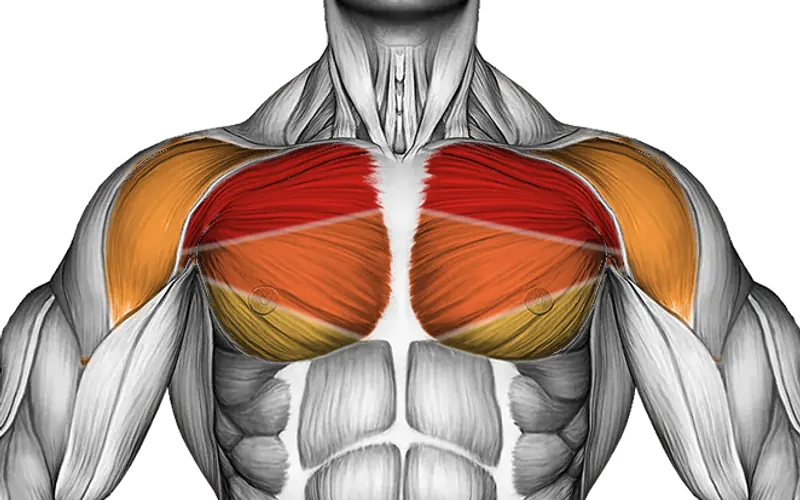
- Upper chest100%
- Middle chest70%
- Lower chest30%
- Front delts50%
How to do it
- Take your bodyweight and set a slight bend in your elbows — then keep that exact angle for every rep of the set.
- Set your shoulder blades back and down so the movement happens at the shoulder, not by shrugging.
- Start with your arms open and the chest already under tension.
- Bring your hands together in a wide hugging arc, thinking about squeezing the chest rather than moving your hands.
- Pause at peak contraction for a beat.
- Open back out slowly until you feel a strong but comfortable stretch, and stop there.
Breathing. Breathe in as you open out, out as you bring your hands together.
Form cues that matter
- Fixed elbow angle — if it changes, it has become a press.
- Hug, do not push.
- Control the stretch; do not fall into it.
- Bending and straightening the elbows, turning it into a press
- Dropping too deep into the stretch with heavy weight
Common mistakes
| The mistake | Do this instead |
|---|---|
| Bending and straightening the elbows, turning it into a press | Lock the elbow angle at the start and lighten the load until you can hold it. |
| Dropping too deep into the stretch with heavy weight | Stop at a strong stretch, not at your end range; the shoulder joint is vulnerable here. |
| Shrugging the shoulders up to help | Pull the blades down before the set and keep them there. |
What makes this variation different
The Suspension Fly is a specific version of this movement, and the details in its name change how it should be performed.
- Using only your bodyweight means you can train anywhere, and it keeps the whole body involved in stabilising the movement. Progress comes from leverage, range and reps rather than from adding plates.
Sets, reps and rest
| Goal | Sets | Reps | Rest |
|---|---|---|---|
| Strength | 3-5 | 10-12 | 60-90 s |
| Muscle growth | 3-4 | 10-20 | 60-90 s |
| Endurance | 2-3 | 20-30 | 60-90 s |
- 6-12Weekly sets
- 3-1-1Tempo
- 60-90 sRest
How to progress
Add reps before you add weight. Stay at the same load until you reach the top of your rep range on every set, then increase the resistance and drop back to the bottom of the range. The Suspension Fly responds better to accumulated quality reps than to heavy jumps.
Variations and alternatives
If you do not have the equipment, or you simply want to rotate the stimulus, these 8 movements train the chest in a similar way.
- Lever Pec Deck Fly — Machine
- Cable Middle Fly — Cable
- Dumbbell Fly — Dumbbell
- Band Face Pull — Resistance band
- Arm Crossover — Bodyweight
- Band Bent Over Rear Lateral Raise — Resistance band
- Band High Fly — Resistance band
- Cable Decline Fly — Cable
Safety
Key takeaways
- Fixed elbow angle — if it changes, it has become a press.
- Hug, do not push.
- Work in the 10-20 rep range for muscle growth, leaving a rep or two in reserve on most sets.
- Full range of motion on the Suspension Fly matters more than the weight on it.
- Progress gradually and keep technique identical as the load goes up.
Go deeper
FAQ
What muscles does the Suspension Fly work?
It works the chest as the prime mover, with front delts assisting. The midsection also works throughout to keep you stable.
How many sets and reps should I do on the Suspension Fly?
Three to four working sets of 10-20 reps suits most people training for muscle growth, leaving one or two reps in reserve. Across all the exercises that train this muscle, 6-12 hard sets a week is a productive range.
Is the Suspension Fly good for beginners?
Yes, provided you start light enough to own the technique. Spend the first few weeks on the movement itself with a load you could do several more reps with, and add weight only once the pattern is automatic.
What can I do instead of the Suspension Fly?
Lever Pec Deck Fly, Cable Middle Fly and Dumbbell Fly all train the chest in a similar way, so any of them works as a substitute when the equipment is taken or you want to rotate the stimulus.
What equipment do I need for the Suspension Fly?
This version uses your bodyweight. The pattern matters more than the tool, though — the alternatives above cover the same movement with whatever you have available.
Track your sets, reps and progress on the Suspension Fly — free, with every exercise in the library.