
Muscle-Group Guides · Beginner · 4 min read
How to Train Your Core for Strength and Abs
Your core is not just your six-pack. It is the whole trunk — abs, obliques, the deep muscles around the spine — and its main job is to stop movement as much as create it. Train all its roles and you get a stronger squat and deadlift, a healthier back and, with low enough body fat, abs you can see.
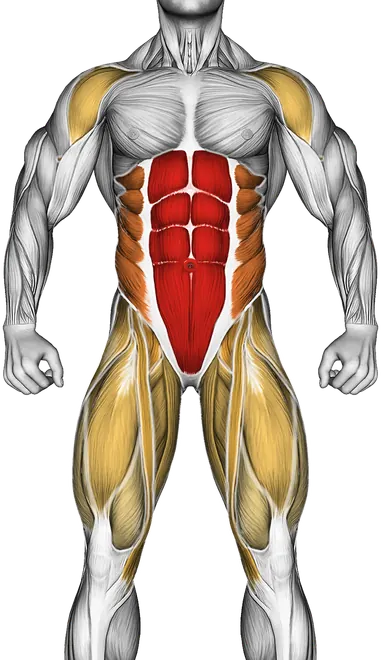 Front
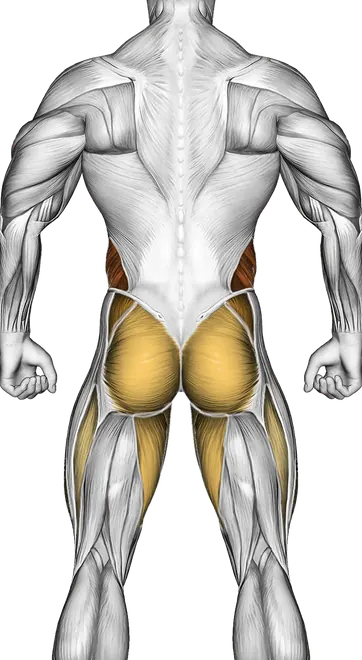 Back
- Rectus abdominis100%
- Hip flexors40%
- Obliques60%
- Gluteus medius40%
- Sartorius31%
On this page
The four jobs of your core
| Job | What it means | Best exercises |
|---|---|---|
| Flexion | Curling the spine forward | Cable crunch, weighted crunch, hanging knee raise |
| Anti-extension | Stopping the lower back from arching | Plank, ab wheel rollout, dead bug |
| Anti-rotation | Stopping the trunk from twisting | Pallof press, single-arm carry |
| Stiffness under load | Holding the trunk rigid while moving weight | Farmer carries, suitcase carries |
The abs are a muscle like any other; flexion exercises train them directly. The other three roles build the kind of trunk stiffness that protects your back and makes heavy lifts stronger.
Progress your core like any other muscle
The biggest mistake in core training is doing the same easy exercise forever. Three sets of 30 bodyweight crunches stop doing much once they are easy. Abs grow the same way other muscles do: hard sets, progressed over time.
- Knee plank3 × 20–30 s
- Front plank3 × 30–60 s
- Long-lever plankElbows further ahead, 3 × 20–40 s
- Ab wheel from knees3 × 6–10
- Ab wheel from feetThe advanced goal
For flexion work, add load: a cable crunch you can take close to failure in 10 to 15 reps builds far more than a hundred easy crunches. Once a plank passes a minute, make it harder rather than longer.
A simple weekly plan
- MonUpperCable crunch 3 × 10–15
- TueLowerPlank or ab wheel 3 sets — after squats, not before
- WedRest
- ThuUpperPallof press 3 × 10 each side
- FriLowerHanging knee raise 3 × 10–15, farmer carry 3 × 30 m
- SatRest
- SunRest
Two to four exercises spread across the week is plenty. Put hard core work at the end of a session, or on a day without heavy squats and deadlifts — a tired trunk makes bracing harder when you need it most. See breathing and bracing.
Visible abs need fat loss
Core training builds the abdominal muscles; body fat decides whether you can see them. For most men that means roughly 10 to 12 percent body fat and for most women roughly 16 to 20 percent — the exact number varies from person to person.
If visible abs are the goal, combine direct core work with a calorie deficit and high protein. Our guides to how to get six-pack abs and the calorie deficit cover the diet side.
Core training and back health
A strong trunk supports every heavy lift, and endurance-focused core work — planks, side planks, bird dogs, carries — is commonly used in programs for people with recurring lower back discomfort. Squats and deadlifts already train bracing, but they do not fully replace direct work for the abs and obliques.
If an exercise hurts your back, swap it: dead bugs instead of sit-ups, Pallof presses instead of heavy twisting. Pain that persists deserves a proper assessment — see lower back pain when lifting.
- The core resists movement as much as it creates it — train all four jobs.
- Use cable crunches, planks or rollouts, Pallof presses and carries.
- Progress core exercises with load and harder variations, not endless reps.
- Train core two to four times a week, away from heavy squats and deadlifts.
- Visible abs also need low body fat — that part happens in the kitchen.
Frequently asked questions
Do squats and deadlifts train abs enough?
They train bracing and trunk stiffness well, but direct core work still improves ab development and trunk control.
Can ab exercises burn belly fat?
No. They build the abdominal muscles, but fat loss comes from a calorie deficit, and you cannot choose where it comes off first.
How often should I train abs?
Two to four times a week works for most lifters, with enough recovery to perform well in your main lifts.
Are sit-ups bad for your back?
Not for most healthy people in reasonable volumes. If they bother your back, swap to cable crunches, dead bugs or planks, which train the abs with less spinal flexion.
How long should I hold a plank?
Build to about 60 seconds with perfect form, then make it harder — longer lever, added weight or an ab wheel — rather than holding it for minutes.
Related guides
How to Get Six-Pack Abs
How to get six-pack abs: why diet reveals abs, the truth about spot reduction, the best core exercises, and how to train and eat for a visible midsection.
Beginner · 3 min read
Breathing and Bracing for Heavy Lifts
How to breathe and brace for heavy lifts: 360-degree bracing step by step, when to breathe during a rep, how to use a lifting belt, and when to be cautious.
Intermediate · 4 min read
Calorie Deficit: The Foundation of Fat Loss
What a calorie deficit is, how to calculate yours from your TDEE, how big it should be, and how to maintain it without losing muscle or your sanity.
Beginner · 4 min read
Full-Body Workout Routine: The Best Plan for Beginners
A complete full-body workout routine: why it is ideal for beginners and busy lifters, a 3-day template, and how to progress for muscle and strength.
Beginner · 3 min read
This guide is general educational information, not medical advice. Train within your ability and consult a qualified professional before starting a new program if you have an injury or health condition.