
Band Decline Sit-Up
The Band Decline Sit-Up is a compound movement that trains the core with help from quadriceps, serratus and abductors. This guide covers the setup, the execution, the mistakes worth fixing early, and how to program it.
Curling the spine against resistance is what trains the core the way these muscles actually function — by shortening, not by being held still. Done with control and against real resistance, it is the most direct route to visible abdominal development.
Who it is for. Anyone building the midsection. Program it at the end of a session, and treat it like any other muscle by adding resistance over time.
Muscles worked
The prime mover here is the core, with quadriceps, serratus and abductors assisting — which is why this movement earns its place as more than a single-muscle exercise.
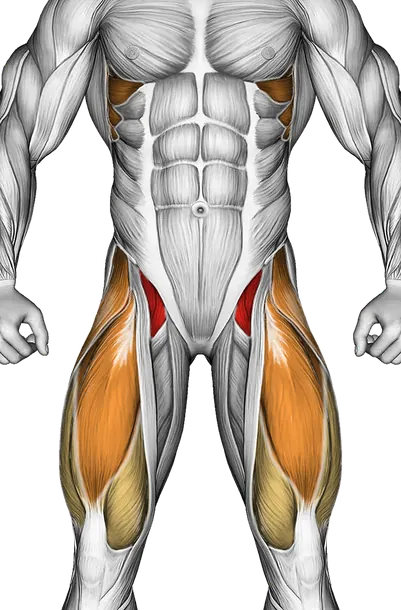 Front
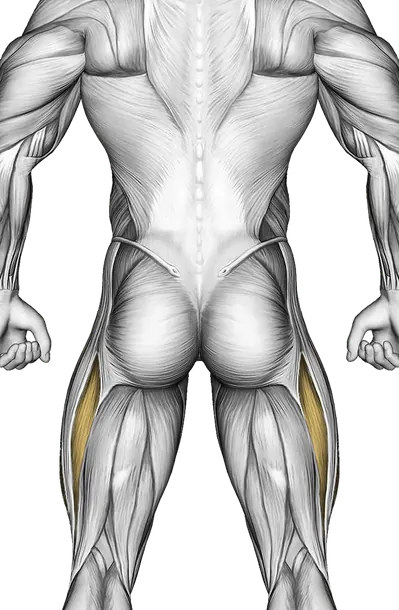 Back
- Hip flexors100%
- Serratus50%
- Tensor fasciae latae50%
- Rectus femoris50%
- Vastus lateralis11%
- Vastus medialis11%
How to do it
- Set up so your lower back is supported and your hips are fixed — the hips must not do the work.
- Take a resistance band if the movement is loaded, and set your hands where they will stay for the whole set.
- Tuck your chin slightly and exhale to pull your ribs toward your hips before the first rep.
- Curl your ribs toward your hips, rolling the spine up one segment at a time rather than hinging at the hip.
- Squeeze the core hard at the top of the range and hold for a beat.
- Uncurl slowly, resisting the way back down, and stop just short of fully relaxing.
Breathing. Breathe out forcefully as you curl up, in as you lower. The exhale is part of the contraction.
Form cues that matter
- Curl the spine; do not hinge at the hip.
- Breathe out hard at the top — it deepens the contraction.
- Slow on the way back down.
- Pulling on the head and neck with the hands
- Hinging at the hips instead of curling the spine
Common mistakes
| The mistake | Do this instead |
|---|---|
| Pulling on the head and neck with the hands | Rest the hands lightly, or cross them on your chest, and let the abs do the pulling. |
| Hinging at the hips instead of curling the spine | Shorten the range to just the part where your spine is actually flexing. |
| Doing endless bodyweight reps and never adding resistance | Hold a plate or use a cable and work in the 12 to 20 rep range instead. |
What makes this variation different
The Band Decline Sit-Up is a specific version of this movement, and the details in its name change how it should be performed.
- A band gets harder as it stretches, so resistance peaks where the muscle is strongest. It is the easiest way to train at home or while travelling, and it is forgiving on the joints, but it is hard to measure progress precisely.
- The decline angle emphasises the lower portion of the chest and shortens the range slightly, which is often easier on the shoulders than a flat or incline press.
Sets, reps and rest
| Goal | Sets | Reps | Rest |
|---|---|---|---|
| Strength | 3-5 | 8-12 | 45-75 s |
| Muscle growth | 3-4 | 12-20 | 45-75 s |
| Endurance | 2-3 | 20-30 | 45-75 s |
- 6-16Weekly sets
- 2-1-2Tempo
- 45-75 sRest
How to progress
Add reps before you add weight. Stay at the same load until you reach the top of your rep range on every set, then increase the resistance and drop back to the bottom of the range. The Band Decline Sit-Up responds better to accumulated quality reps than to heavy jumps.
Variations and alternatives
If you do not have the equipment, or you simply want to rotate the stimulus, these 8 movements train the core in a similar way.
- Crunch Floor — Bodyweight
- Cable Standing Crunch — Cable
- 3 4 Sit-Up — Bodyweight
- Band Jack Knife Sit-Up — Resistance band
- Band Kneeling Crunch — Resistance band
- Band Standing Crunch — Resistance band
- Bottoms Up — Bodyweight
- Cable Judo Flip — Cable
Safety
Key takeaways
- Curl the spine; do not hinge at the hip.
- Breathe out hard at the top — it deepens the contraction.
- Work in the 12-20 rep range for muscle growth, leaving a rep or two in reserve on most sets.
- Full range of motion on the Band Decline Sit-Up matters more than the weight on it.
- Progress gradually and keep technique identical as the load goes up.
Go deeper
FAQ
What muscles does the Band Decline Sit-Up work?
It works the core as the prime mover, with quadriceps, serratus and abductors assisting. The midsection also works throughout to keep you stable.
How many sets and reps should I do on the Band Decline Sit-Up?
Three to four working sets of 12-20 reps suits most people training for muscle growth, leaving one or two reps in reserve. Across all the exercises that train this muscle, 6-16 hard sets a week is a productive range.
Is the Band Decline Sit-Up good for beginners?
Yes, provided you start light enough to own the technique. Spend the first few weeks on the movement itself with a load you could do several more reps with, and add weight only once the pattern is automatic.
What can I do instead of the Band Decline Sit-Up?
Crunch Floor, Cable Standing Crunch and 3 4 Sit-Up all train the core in a similar way, so any of them works as a substitute when the equipment is taken or you want to rotate the stimulus.
What equipment do I need for the Band Decline Sit-Up?
This version uses a resistance band. The pattern matters more than the tool, though — the alternatives above cover the same movement with whatever you have available.
Track your sets, reps and progress on the Band Decline Sit-Up — free, with every exercise in the library.