
Donkey Calf Raise
The Donkey Calf Raise is an isolation movement that targets the calves directly. This guide covers the setup, the execution, the mistakes worth fixing early, and how to program it.
Rising onto the toes against resistance is the only way to properly load the calves. Calves are built for thousands of daily contractions, so they respond to a full stretch, a hard squeeze and more reps than most muscles need.
Who it is for. Anyone who wants calves that grow, which usually means anyone who has found that walking is not enough. Program them at the end of a lower-body session.
Muscles worked
Effectively all of the work here falls on the calves, which is what makes this such a precise way to add volume to it.
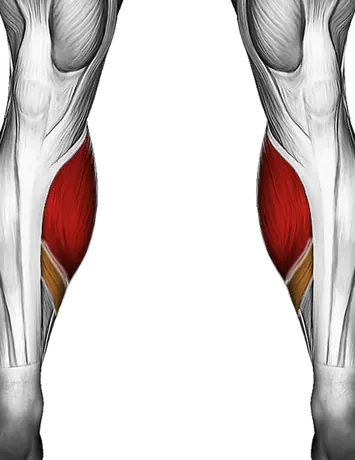 Front
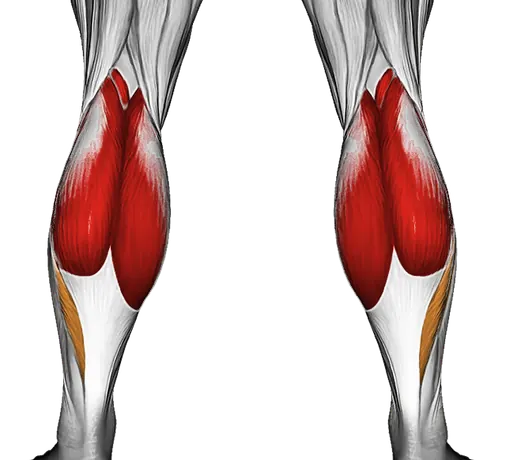 Back
- Gastrocnemius100%
- Soleus49%
How to do it
- Place the balls of your feet on the platform or step with your heels free to drop below the toes.
- Take the load with your bodyweight and stand or sit tall, with your knees set for the position the movement calls for.
- Point your toes straight ahead unless you are deliberately working a different part of the muscle.
- Let your heels sink as far below the platform as they comfortably go, and feel the stretch.
- Press up onto the toes as high as you can and hold the top contraction for a full second.
- Lower slowly under control — the stretch under load is where most of the growth comes from.
Breathing. Breathe out as you press up, in as you lower. Keep it relaxed.
Form cues that matter
- Full stretch at the bottom, full height at the top.
- Pause one second at the top of every rep.
- No bouncing — the tendon should not be doing the work.
- Bouncing rapidly through a short range
- Never pausing at the top
Common mistakes
| The mistake | Do this instead |
|---|---|
| Bouncing rapidly through a short range | Halve the weight and take three seconds per rep through the full range. |
| Never pausing at the top | Add a deliberate one-second squeeze; it is the difference between a rep and a bob. |
| Loading so heavy the heels never drop | Use a weight that lets you reach a genuine stretch at the bottom. |
What makes this variation different
The Donkey Calf Raise is a specific version of this movement, and the details in its name change how it should be performed.
- Using only your bodyweight means you can train anywhere, and it keeps the whole body involved in stabilising the movement. Progress comes from leverage, range and reps rather than from adding plates.
Sets, reps and rest
| Goal | Sets | Reps | Rest |
|---|---|---|---|
| Strength | 3-5 | 8-10 | 60-90 s |
| Muscle growth | 3-4 | 10-20 | 60-90 s |
| Endurance | 2-3 | 20-30 | 60-90 s |
- 8-16Weekly sets
- 3-2-1Tempo
- 60-90 sRest
How to progress
Add weight before you add reps. Work at the top of your rep range for two sessions in a row with clean technique, then put the smallest increment available on the Donkey Calf Raise and build back up. Small, boring jumps beat big ones.
Strength standards
How much you should be lifting on the Donkey Calf Raise, as a multiple of your bodyweight, from a first attempt through to a competitive standard.
| Level | Male | Female |
|---|---|---|
| Beginner | 0.75x | - |
| Novice | 1.5x | - |
| Intermediate | 2.5x | - |
| Advanced | 3.5x | - |
| Elite | 4.5x | - |
Variations and alternatives
If you do not have the equipment, or you simply want to rotate the stimulus, these 8 movements train the calves in a similar way.
- Standing Calf Raise (on a Staircase) — Bodyweight
- Dumbbell Standing Calf Raise — Dumbbell
- Band Two Legs Calf Raise (Band Under Both Legs) (Version 2) — Resistance band
- Barbell Seated Calf Raise — Barbell
- Barbell Standing Calf Raise — Barbell
- Dumbbell Seated Calf Raise — Dumbbell
- Dumbbell Single Leg Calf Raise — Dumbbell
- Kettlebell Standing Calf Raise — Kettlebell
Safety
Key takeaways
- Full stretch at the bottom, full height at the top.
- Pause one second at the top of every rep.
- Work in the 10-20 rep range for muscle growth, leaving a rep or two in reserve on most sets.
- Full range of motion on the Donkey Calf Raise matters more than the weight on it.
- Progress gradually and keep technique identical as the load goes up.
Go deeper
FAQ
What muscles does the Donkey Calf Raise work?
It works the calves as the prime mover. The midsection also works throughout to keep you stable.
How many sets and reps should I do on the Donkey Calf Raise?
Three to four working sets of 10-20 reps suits most people training for muscle growth, leaving one or two reps in reserve. Across all the exercises that train this muscle, 8-16 hard sets a week is a productive range.
Is the Donkey Calf Raise good for beginners?
Yes, provided you start light enough to own the technique. Spend the first few weeks on the movement itself with a load you could do several more reps with, and add weight only once the pattern is automatic.
What can I do instead of the Donkey Calf Raise?
Standing Calf Raise (on a Staircase), Dumbbell Standing Calf Raise and Band Two Legs Calf Raise (Band Under Both Legs) (Version 2) all train the calves in a similar way, so any of them works as a substitute when the equipment is taken or you want to rotate the stimulus.
What equipment do I need for the Donkey Calf Raise?
This version uses your bodyweight. The pattern matters more than the tool, though — the alternatives above cover the same movement with whatever you have available.
What is a good Donkey Calf Raise?
The table above gives the standards as a multiple of bodyweight, from beginner through to elite. Compare your best set against your own bodyweight rather than against the person next to you.
Track your sets, reps and progress on the Donkey Calf Raise — free, with every exercise in the library.