
Dumbbell Sumo Pull Through
The Dumbbell Sumo Pull Through is a compound movement that trains the lower back with help from glutes and hamstrings. This guide covers the setup, the execution, the mistakes worth fixing early, and how to program it.
The hip hinge is how you pick things up: hips travel back, the torso folds forward, and the load lands on the lower back through a long stretch. It is the single most transferable strength pattern there is, and the one most often done with a rounded back.
Who it is for. Everyone, but the loading has to be earned — learn the pattern light before it gets heavy. Place it first or second in a lower-body or pull session.
Muscles worked
The prime mover here is the lower back, with glutes and hamstrings assisting — which is why this movement earns its place as more than a single-muscle exercise.
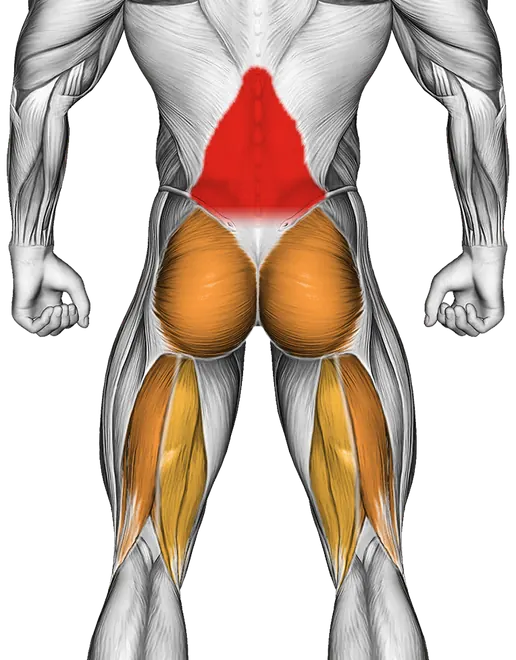
- Spinal erectors100%
- Gluteus maximus50%
- Biceps femoris50%
- Semitendinosus36%
How to do it
- Stand with your feet about hip-width and your weight over the middle of the foot, holding a dumbbell.
- Set your back flat, pull your shoulder blades down, and brace hard — the brace is what protects your spine.
- Soften the knees slightly. The hinge is a hip movement, not a squat.
- Push your hips straight back and let your torso fold forward, keeping the load tight against your legs.
- Go down until you feel a strong stretch in the lower back, stopping the moment your lower back starts to round.
- Drive your hips forward to stand tall, squeezing your glutes at the top without leaning back.
Breathing. Breathe in and brace at the top, hold through the rep, and breathe out at lockout. Re-brace before each rep rather than breathing at the bottom.
Form cues that matter
- Hips back, not down — the knees barely move.
- Keep the load dragging up your legs the whole way.
- Finish by standing tall, not by hyperextending.
- Rounding the lower back as you reach the bottom
- Turning it into a squat by bending the knees
Common mistakes
| The mistake | Do this instead |
|---|---|
| Rounding the lower back as you reach the bottom | Shorten the range to where you can hold a flat back, and rebuild depth as your hamstring flexibility improves. |
| Turning it into a squat by bending the knees | Set the knee angle at the start and hold it — only the hips should move. |
| Letting the load drift away from your body | Actively pull it back into your legs; a load that drifts forward multiplies the stress on your spine. |
What makes this variation different
The Dumbbell Sumo Pull Through is a specific version of this movement, and the details in its name change how it should be performed.
- Dumbbells let each side work independently, which exposes and fixes imbalances, and they allow a more natural path than a fixed bar. Expect to use less total weight than the barbell version.
- The wide sumo stance shortens the range of motion and shifts work toward the hips, glutes and inner thighs while asking less of the lower back. It needs more hip mobility than a conventional stance.
Sets, reps and rest
| Goal | Sets | Reps | Rest |
|---|---|---|---|
| Strength | 3-5 | 3-6 | 2-4 min |
| Muscle growth | 3-4 | 6-12 | 2-4 min |
| Endurance | 2-3 | 12-20 | 2-4 min |
- 8-16Weekly sets
- 2-1-1Tempo
- 2-4 minRest
How to progress
Add weight before you add reps. Work at the top of your rep range for two sessions in a row with clean technique, then put the smallest increment available on the Dumbbell Sumo Pull Through and build back up. Small, boring jumps beat big ones.
Variations and alternatives
If you do not have the equipment, or you simply want to rotate the stimulus, these 8 movements train the lower back in a similar way.
- Barbell Deadlift — Barbell
- Barbell Romanian Deadlift — Barbell
- Barbell Sumo Deadlift — Barbell
- Kettlebell Swing — Kettlebell
- Band Deadlift — Resistance band
- Band Pull Through — Resistance band
- Barbell Good Morning — Barbell
- Barbell Seated Good Morning — Barbell
Safety
Key takeaways
- Hips back, not down — the knees barely move.
- Keep the load dragging up your legs the whole way.
- Work in the 6-12 rep range for muscle growth, leaving a rep or two in reserve on most sets.
- Full range of motion on the Dumbbell Sumo Pull Through matters more than the weight on it.
- Progress gradually and keep technique identical as the load goes up.
Go deeper
FAQ
What muscles does the Dumbbell Sumo Pull Through work?
It works the lower back as the prime mover, with glutes and hamstrings assisting. The midsection also works throughout to keep you stable.
How many sets and reps should I do on the Dumbbell Sumo Pull Through?
Three to four working sets of 6-12 reps suits most people training for muscle growth, leaving one or two reps in reserve. Across all the exercises that train this muscle, 8-16 hard sets a week is a productive range.
Is the Dumbbell Sumo Pull Through good for beginners?
Yes, provided you start light enough to own the technique. Spend the first few weeks on the movement itself with a load you could do several more reps with, and add weight only once the pattern is automatic.
What can I do instead of the Dumbbell Sumo Pull Through?
Barbell Deadlift, Barbell Romanian Deadlift and Barbell Sumo Deadlift all train the lower back in a similar way, so any of them works as a substitute when the equipment is taken or you want to rotate the stimulus.
What equipment do I need for the Dumbbell Sumo Pull Through?
This version uses a dumbbell. The pattern matters more than the tool, though — the alternatives above cover the same movement with whatever you have available.
Track your sets, reps and progress on the Dumbbell Sumo Pull Through — free, with every exercise in the library.