
Lifting Technique · Intermediate · 4 min read
Romanian Deadlift Form: How to Train Hamstrings and Glutes
The Romanian deadlift is one of the best exercises there is for the hamstrings and glutes, because it loads them in a deep stretch — the position research increasingly links to the most growth. The whole lift comes down to one skill: hinging at the hips while everything else stays still.
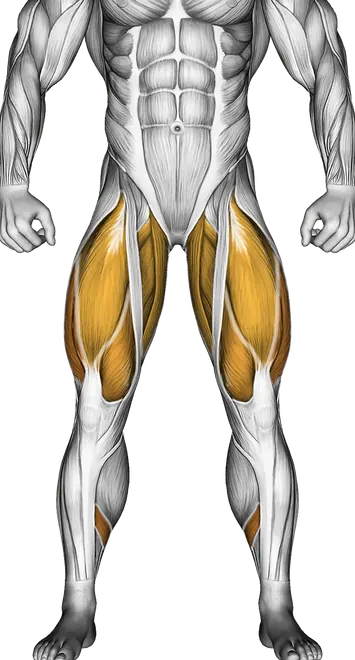 Front
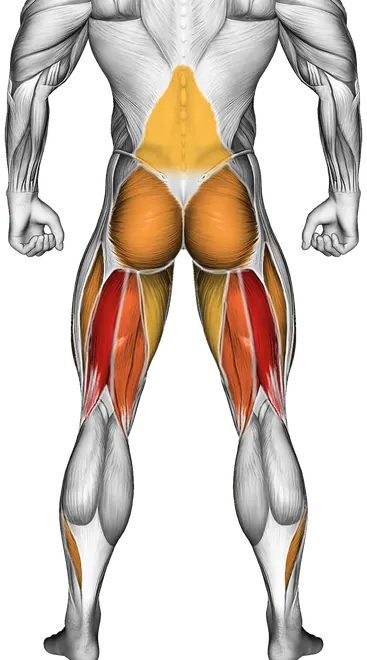 Back
- Biceps femoris100%
- Semitendinosus72%
- Gluteus maximus50%
- Vastus lateralis50%
- Soleus50%
- Vastus medialis40%
- Rectus femoris35%
- Spinal erectors33%
- Adductors33%
On this page
Setup
Start standing, not from the floor: deadlift the bar up from the rack or the floor for the first rep, or pick it off safety pins at hip height. Take a grip just outside your thighs, with a double overhand grip or straps once the weight gets heavy.
Soften your knees a little — about 15 to 20 degrees — and then leave them there. Brace your trunk as if about to be pushed, pull your shoulders slightly down and back, and keep the bar touching your thighs.
The hinge
- Take a breath and brace before you move.
- Push your hips straight back, as if closing a car door with your backside.
- Let the bar slide down your thighs, staying in contact with your legs.
- Keep your back flat and your neck in line — look at the floor a couple of metres ahead.
- Stop when your hamstrings are fully stretched and your hips will not go further back.
- Drive your hips forward and squeeze your glutes to stand tall — no leaning back.
Lower under control — about two to three seconds — and do not bounce out of the bottom. The stretch is where the work is being done; rushing through it wastes the best part of the exercise.
How low should you go?
As low as your hips can go back while your spine stays still. For most people that is between just below the knee and mid-shin. Some very mobile lifters reach the floor; many stop at the knee. Both are fine.
The test is simple: when your hips stop moving back, the rep is over. Anything lower comes from your lower back rounding, not from your hamstrings stretching — which adds risk and takes the work away from the muscles you are trying to train. Range comes with practice: as your hinge improves over a few weeks, most people gain a few centimetres naturally.
Common mistakes
- Hips travel back, knees stay at the same slight bend
- Bar stays in contact with the legs the whole way
- Flat back, neutral neck, braced trunk
- Slow lowering, strong hip drive to stand
- Bending the knees more and more — that turns it into a squat
- Letting the bar drift forward away from the legs
- Chasing the floor by rounding the lower back
- Leaning back at the top or bouncing out of the bottom
If you feel it mostly in your lower back, the bar is probably drifting forward or your back is rounding at the bottom. Lighten the load, shorten the range and film a set from the side.
Programming the RDL
Use RDLs for 2 to 4 sets of 6 to 12 reps, one to three reps short of failure. Because grip and lower back fatigue add up, keep the reps moderate rather than going to 20.
- On a lower day: after squats, as the main hamstring and glute exercise.
- On a pull day: as the leg exercise that pairs with back work.
- As a deadlift assistance lift: it strengthens the hip hinge and the position off the floor — see how to increase your deadlift.
Dumbbells are a great way to learn the pattern; the barbell is easier to load heavily. The single-leg version adds balance and a huge glute stretch with much less weight. For the full hamstring and glute picture, see how to build bigger legs and how to build bigger glutes.
- The RDL is a hip hinge: hips go back, knees stay softly bent and still.
- Keep the weight against your legs and your back flat throughout.
- Stop when your hips stop moving back — usually around mid-shin.
- Control the lowering; the loaded stretch is where the growth is.
- Program 2 to 4 sets of 6 to 12 reps after squats or on a pull day.
Frequently asked questions
Should Romanian deadlifts touch the floor?
Usually no. Most people stop around mid-shin, where the hamstring stretch is strong and the spine stays still. Only go lower if your hips are still moving back.
Are RDLs for the back or the legs?
Mainly the hamstrings and glutes. The back works hard to hold its position, but it should not bend and straighten during the rep.
Dumbbells or barbell for RDLs?
Both work. Dumbbells are great for learning and feel natural for many people; a barbell is easier to load heavily and progress in small steps.
What is the difference between an RDL and a stiff-leg deadlift?
An RDL starts from standing with soft knees and stops at the hamstring stretch. A stiff-leg deadlift usually starts from the floor with straighter legs each rep. The RDL is easier to keep in a good position.
Should I use straps for RDLs?
Yes once your grip fails before your hamstrings do. Straps let you train the target muscles fully; train grip separately if it matters to you.
Related guides
Deadlift Form: How to Deadlift Safely and Strongly
How to deadlift with proper form: setup, neutral back, bracing, bar path and lockout, plus the common mistakes that cause back pain.
Beginner · 4 min read
How to Increase Your Deadlift
How to increase your deadlift: a better start position, fixing where the bar slows, building the posterior chain and grip, and how often to pull heavy.
Intermediate · 4 min read
How to Build Bigger Legs
How to build bigger legs: training quads, hamstrings and calves, the best leg exercises, why you should not skip leg day, and how to progress.
Intermediate · 3 min read
How to Build Bigger Glutes
How to build bigger, stronger glutes: the best glute exercises, why hip thrusts and squats matter, ideal volume and progression, and common mistakes.
Intermediate · 3 min read
This guide is general educational information, not medical advice. Train within your ability and consult a qualified professional before starting a new program if you have an injury or health condition.