
Kettlebell Goblet Squat
The Kettlebell Goblet Squat is a compound movement that trains the quadriceps with help from glutes, adductors, calves, abductors and hamstrings. This guide covers the setup, the execution, the mistakes worth fixing early, and how to program it.
The squat is the most complete lower-body movement there is. Bending at the hips, knees and ankles under load trains the quadriceps through a long range while the whole trunk works to keep you upright, which is why almost every serious program is built around some version of it.
Who it is for. Everyone from a first-week beginner to an advanced lifter, scaled by load and depth. Put it first in a session, when you are freshest.
Muscles worked
The prime mover here is the quadriceps, with glutes, adductors, calves, abductors and hamstrings assisting — which is why this movement earns its place as more than a single-muscle exercise.
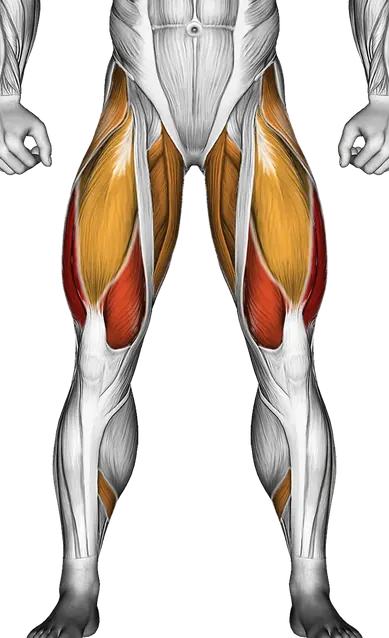 Front
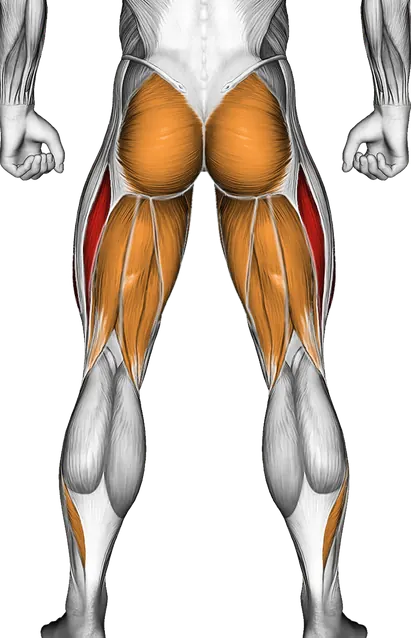 Back
- Vastus lateralis100%
- Vastus medialis82%
- Rectus femoris40%
- Gluteus maximus50%
- Tensor fasciae latae50%
- Adductors50%
- Biceps femoris50%
- Semitendinosus50%
- Soleus50%
How to do it
- Set your stance about shoulder-width, toes turned out somewhere between 15 and 30 degrees, and find a foot position where your knees track in line with your toes.
- Take the load with a kettlebell, brace your midsection as if about to be poked in the stomach, and pull your ribs down so your lower back is neither arched hard nor rounded.
- Screw your feet into the floor to build tension through the hips before the first rep, and fix your eyes on a point a few metres ahead.
- Break at the hips and knees together and descend under control, keeping your weight over the middle of your foot.
- Go down until your hip crease passes below the top of your knee, or as deep as you can reach without your lower back tucking under.
- Drive back up through the whole foot, keeping your chest and hips rising at the same rate, and stand tall without leaning back at the top.
Breathing. Take a big breath at the top, hold it through the descent and the hardest part of the drive up, then breathe out once past the sticking point.
Form cues that matter
- Spread the floor with your feet — it stops the knees caving in.
- Keep the bar or load stacked over your mid-foot the whole way down.
- Hips and shoulders rise together out of the bottom.
- Knees collapsing inward as you stand up
- Heels lifting, or the torso folding forward
Common mistakes
| The mistake | Do this instead |
|---|---|
| Knees collapsing inward as you stand up | Lighten the load and actively push your knees out over your toes; add glute and abductor work. |
| Heels lifting, or the torso folding forward | Work on ankle mobility, widen the stance slightly, and squat only as deep as you can with flat feet. |
| The lower back tucking under at the bottom ("butt wink") | Stop the descent just above the point where it happens and build depth from there over weeks. |
What makes this variation different
The Kettlebell Goblet Squat is a specific version of this movement, and the details in its name change how it should be performed.
- A kettlebell hangs its weight below the handle, so the load pulls on you differently through the range. That makes it excellent for movements with a swing or a rack position, and it demands more grip than a dumbbell.
- Holding the weight at the chest acts as a counterbalance, which lets most people reach a deeper, more upright position than they can with a bar on their back. It is the best way to learn the pattern.
Sets, reps and rest
| Goal | Sets | Reps | Rest |
|---|---|---|---|
| Strength | 3-5 | 3-6 | 2-4 min |
| Muscle growth | 3-4 | 6-12 | 2-4 min |
| Endurance | 2-3 | 12-20 | 2-4 min |
- 10-20Weekly sets
- 2-0-1Tempo
- 2-4 minRest
How to progress
Add weight before you add reps. Work at the top of your rep range for two sessions in a row with clean technique, then put the smallest increment available on the Kettlebell Goblet Squat and build back up. Small, boring jumps beat big ones.
Strength standards
How much you should be lifting on the Kettlebell Goblet Squat, as a multiple of your bodyweight, from a first attempt through to a competitive standard.
| Level | Male | Female |
|---|---|---|
| Beginner | 0.25x | - |
| Novice | 0.45x | - |
| Intermediate | 0.7x | - |
| Advanced | 0.95x | - |
| Elite | 1.2x | - |
Variations and alternatives
If you do not have the equipment, or you simply want to rotate the stimulus, these 8 movements train the quadriceps in a similar way.
- Barbell Narrow Stance Squat — Barbell
- Barbell Front Squat — Barbell
- Lever Horizontal Leg Press — Machine
- Sled Hack Squat — Machine
- Back Forward Leg Swings — Bodyweight
- Balance Board (Version 2) — Bodyweight
- Barbell Bench Front Squat — Barbell
- Barbell Bench Squat — Barbell
Safety
Key takeaways
- Spread the floor with your feet — it stops the knees caving in.
- Keep the bar or load stacked over your mid-foot the whole way down.
- Work in the 6-12 rep range for muscle growth, leaving a rep or two in reserve on most sets.
- Full range of motion on the Kettlebell Goblet Squat matters more than the weight on it.
- Progress gradually and keep technique identical as the load goes up.
Go deeper
FAQ
What muscles does the Kettlebell Goblet Squat work?
It works the quadriceps as the prime mover, with glutes, adductors, calves, abductors and hamstrings assisting. The midsection also works throughout to keep you stable.
How many sets and reps should I do on the Kettlebell Goblet Squat?
Three to four working sets of 6-12 reps suits most people training for muscle growth, leaving one or two reps in reserve. Across all the exercises that train this muscle, 10-20 hard sets a week is a productive range.
Is the Kettlebell Goblet Squat good for beginners?
Yes, provided you start light enough to own the technique. Spend the first few weeks on the movement itself with a load you could do several more reps with, and add weight only once the pattern is automatic.
What can I do instead of the Kettlebell Goblet Squat?
Barbell Narrow Stance Squat, Barbell Front Squat and Lever Horizontal Leg Press all train the quadriceps in a similar way, so any of them works as a substitute when the equipment is taken or you want to rotate the stimulus.
What equipment do I need for the Kettlebell Goblet Squat?
This version uses a kettlebell. The pattern matters more than the tool, though — the alternatives above cover the same movement with whatever you have available.
What is a good Kettlebell Goblet Squat?
The table above gives the standards as a multiple of bodyweight, from beginner through to elite. Compare your best set against your own bodyweight rather than against the person next to you.
Track your sets, reps and progress on the Kettlebell Goblet Squat — free, with every exercise in the library.