
Resistance Band Leg Extension
The Resistance Band Leg Extension is an isolation movement that targets the quadriceps directly. This guide covers the setup, the execution, the mistakes worth fixing early, and how to program it.
Working the knee joint on its own removes the hips from the equation and puts every bit of the load on the quadriceps. That makes it a precise way to add volume to a muscle that a compound lift shares out across a whole leg.
Who it is for. Useful for everyone, and especially valuable when you want more leg volume than your lower back or grip can absorb. Program it after your compound work.
Muscles worked
Effectively all of the work here falls on the quadriceps, which is what makes this such a precise way to add volume to it.
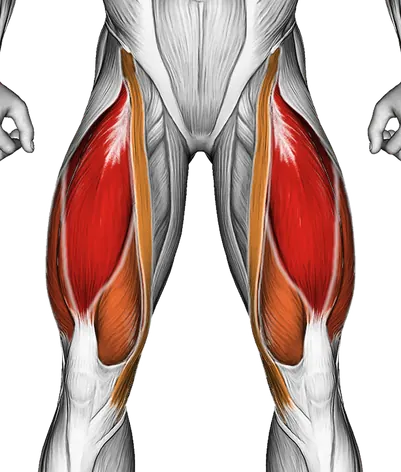 Front
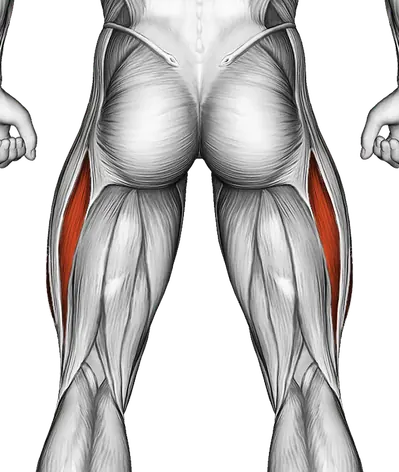 Back
- Rectus femoris100%
- Vastus lateralis82%
- Vastus medialis70%
- Sartorius52%
How to do it
- Set the machine so the pivot lines up with your knee joint — that alignment is what keeps the load on the muscle instead of the joint.
- Adjust the pad so it sits against the soft part of your leg, not across a joint, and fasten the belt if there is one.
- Sit or lie back against the support with your hips held still.
- Move the pad through the full range using only the knee joint, and pause at the point of hardest work for the quadriceps.
- Squeeze for a beat at peak contraction rather than rushing straight into the return.
- Return slowly, resisting the weight all the way back to a full stretch before the next rep.
Breathing. Breathe out as you contract, in as you return. There is no need to hold your breath on an isolation movement.
Form cues that matter
- Only the knee moves — hips stay pinned to the pad.
- Squeeze at the end range; that is where the work is.
- Take longer to lower than to lift.
- Swinging the weight up with a hip thrust or a jerk
- Cutting the range short at both ends
Common mistakes
| The mistake | Do this instead |
|---|---|
| Swinging the weight up with a hip thrust or a jerk | Drop the load until you can move it with the target muscle alone. |
| Cutting the range short at both ends | Use a weight that lets you reach full stretch and full contraction on every rep. |
| A pivot that does not line up with your knee | Re-set the seat before your first set; it takes ten seconds and it changes where the load lands. |
What makes this variation different
The Resistance Band Leg Extension is a specific version of this movement, and the details in its name change how it should be performed.
- A band gets harder as it stretches, so resistance peaks where the muscle is strongest. It is the easiest way to train at home or while travelling, and it is forgiving on the joints, but it is hard to measure progress precisely.
Sets, reps and rest
| Goal | Sets | Reps | Rest |
|---|---|---|---|
| Strength | 3-5 | 8-10 | 60-90 s |
| Muscle growth | 3-4 | 10-15 | 60-90 s |
| Endurance | 2-3 | 15-25 | 60-90 s |
- 6-12Weekly sets
- 3-1-1Tempo
- 60-90 sRest
How to progress
Add weight before you add reps. Work at the top of your rep range for two sessions in a row with clean technique, then put the smallest increment available on the Resistance Band Leg Extension and build back up. Small, boring jumps beat big ones.
Variations and alternatives
If you do not have the equipment, or you simply want to rotate the stimulus, these 8 movements train the quadriceps in a similar way.
- Lever Leg Extension — Machine
- Lever Lying Leg Curl — Machine
- Lever Seated Leg Curl — Machine
- Band Seated Leg Extension — Resistance band
- Band Standing Leg Curl — Resistance band
- Exercise Ball One Legged Diagonal Kick Hamstring Curl — Bodyweight
- Inverse Leg Curl with Bench Pads — Bodyweight
- Lever Kneeling Leg Curl (Plate Loaded) — Machine
Safety
Key takeaways
- Only the knee moves — hips stay pinned to the pad.
- Squeeze at the end range; that is where the work is.
- Work in the 10-15 rep range for muscle growth, leaving a rep or two in reserve on most sets.
- Full range of motion on the Resistance Band Leg Extension matters more than the weight on it.
- Progress gradually and keep technique identical as the load goes up.
Go deeper
FAQ
What muscles does the Resistance Band Leg Extension work?
It works the quadriceps as the prime mover. The midsection also works throughout to keep you stable.
How many sets and reps should I do on the Resistance Band Leg Extension?
Three to four working sets of 10-15 reps suits most people training for muscle growth, leaving one or two reps in reserve. Across all the exercises that train this muscle, 6-12 hard sets a week is a productive range.
Is the Resistance Band Leg Extension good for beginners?
Yes, provided you start light enough to own the technique. Spend the first few weeks on the movement itself with a load you could do several more reps with, and add weight only once the pattern is automatic.
What can I do instead of the Resistance Band Leg Extension?
Lever Leg Extension, Lever Lying Leg Curl and Lever Seated Leg Curl all train the quadriceps in a similar way, so any of them works as a substitute when the equipment is taken or you want to rotate the stimulus.
What equipment do I need for the Resistance Band Leg Extension?
This version uses a resistance band. The pattern matters more than the tool, though — the alternatives above cover the same movement with whatever you have available.
Track your sets, reps and progress on the Resistance Band Leg Extension — free, with every exercise in the library.