
Lifting Technique · Intermediate · 4 min read
Barbell Row Form: Build a Stronger Back
The barbell row builds a thick, strong back and a sturdier hinge at the same time — but only when you can hold your position and move the bar, not your body. If your torso moves more than the bar, your back is not getting the work you think it is.
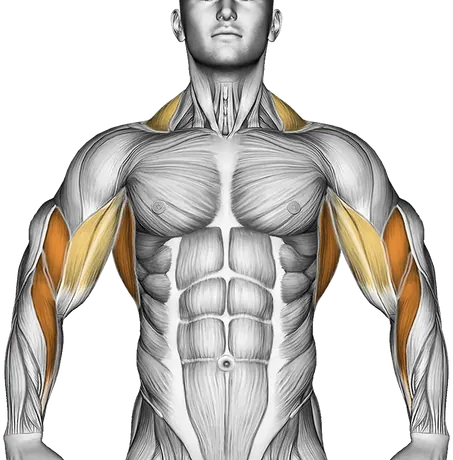 Front
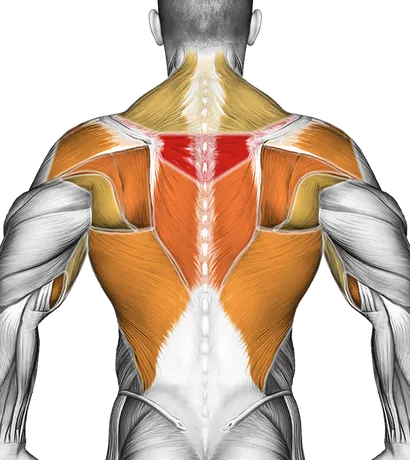 Back
- Middle traps100%
- Lower traps65%
- Rotator cuff59%
- Rear delts50%
- Latissimus50%
- Brachialis50%
- Brachioradialis50%
- Teres major25%
On this page
Setup
- Deadlift the bar to standing with a grip just wider than shoulder width.
- Soften your knees and push your hips back until your torso is 30 to 60 degrees from the floor.
- Brace your trunk and set your back flat, neck in line.
- Let the bar hang at arm's length below your shoulders, close to your thighs.
The exact angle depends on your build and the weight, but it should stay fixed for the set. A more horizontal torso trains more upper back; a more upright one lets you handle more weight but shortens the range.
The row
Pull the bar toward your lower ribs or upper stomach, driving the elbows back and slightly out. Squeeze your shoulder blades together at the top without shrugging your shoulders toward your ears. Pause briefly, then lower the bar under control until your arms are straight and your upper back stretches forward.
Breathe in and brace before each rep, and breathe out at the top. Your hips and lower back should act as a solid bench you are rowing from — still, braced and quiet.
Common mistakes
- Fixed torso angle for the whole set
- Bar pulled to the lower ribs or upper stomach
- Shoulder blades squeeze together at the top
- Slow lowering to a full stretch
- Standing up a little more on every rep
- Jerking the bar with the hips and lower back
- Shrugging instead of rowing
- Dropping the bar and cutting the stretch short
A little body English on the last rep or two is fine for experienced lifters. When every rep needs a hip thrust to get the bar up, the weight is too heavy. Drop it by 10 to 20 percent, or switch to a chest-supported row for a few weeks while your hinge endurance catches up.
Variations
| Bent-over row | Pendlay row | |
|---|---|---|
| Start position | Bar hangs, torso at 30 to 60 degrees | Bar on the floor, torso near horizontal |
| Each rep | Continuous tension | Dead stop on the floor |
| Best for | Muscle growth, back thickness | Power, strict technique |
| Lower-back demand | Higher — you hold the hinge | Lower — you reset each rep |
The underhand row brings in more lats and biceps and lets many people row heavier. The chest-supported row (on an incline bench or a T-bar machine) removes the lower back entirely, which makes it the best choice on days your back is tired from squats or deadlifts. For the pulling family as a whole, see pull-ups and rows.
Programming
Use 3 to 4 sets of 6 to 12 reps, one to three reps short of failure. Heavier sets of 5 to 8 suit strength-focused programs; 8 to 12 suits muscle growth.
- Upper day or pull day: as the main horizontal row, paired with a vertical pull such as the lat pulldown.
- After deadlifts: consider the chest-supported version, so your lower back is not the limit.
- Balance with pressing: a row for every press keeps shoulders healthy and posture strong.
Bracing well is what makes heavy rows safe and productive — breathing and bracing explains the technique in detail.
- Hinge to 30 to 60 degrees and hold that angle for the whole set.
- Pull to the lower ribs, drive the elbows back, squeeze the shoulder blades.
- Lower under control to a full stretch.
- If every rep needs a hip thrust, the weight is too heavy.
- Use chest-supported rows when your lower back limits the set.
Frequently asked questions
What angle should my torso be?
Anywhere from about 30 to 60 degrees works. The key is keeping the angle the same from the first rep to the last.
Are barbell rows bad for the lower back?
Not inherently, but they demand bracing and hinge endurance. If your lower back limits your back training, use chest-supported rows and build the hinge separately.
Should the bar touch the floor each rep?
Only on Pendlay rows. On standard bent-over rows, the bar stays in the air to keep tension on the back.
Overhand or underhand grip?
Both work. Overhand emphasises the upper back a little more; underhand brings in more lats and biceps and often lets you row heavier.
How heavy should barbell rows be?
Heavy enough to reach one to three reps from failure in your target range with a still torso. For many lifters that ends up around 60 to 80 percent of their bench press.
Related guides
Pull-Ups and Rows: How to Build a Strong Back
How to do pull-ups and rows with proper form: grip, scapular control, full range of motion, and the mistakes that turn back exercises into arm exercises.
Beginner · 4 min read
Lat Pulldown Form: How to Train Your Back Properly
Lat pulldown form, step by step: setup, grip width, how to pull with your elbows, how far to lean, common mistakes and how to finally feel your lats working.
Beginner · 4 min read
How to Build a Wider, Thicker Back
How to build a bigger back: training for width and thickness, the best vertical and horizontal pulling exercises, ideal volume, and common mistakes.
Intermediate · 3 min read
Breathing and Bracing for Heavy Lifts
How to breathe and brace for heavy lifts: 360-degree bracing step by step, when to breathe during a rep, how to use a lifting belt, and when to be cautious.
Intermediate · 4 min read
This guide is general educational information, not medical advice. Train within your ability and consult a qualified professional before starting a new program if you have an injury or health condition.