
Lifting Technique · Beginner · 4 min read
Lat Pulldown Form: How to Train Your Back Properly
The lat pulldown is one of the best back builders in the gym — when it is done as a back exercise, not a leaning, swinging biceps curl. A few setup details and one change in how you think about the pull put the work where it belongs: in the lats.

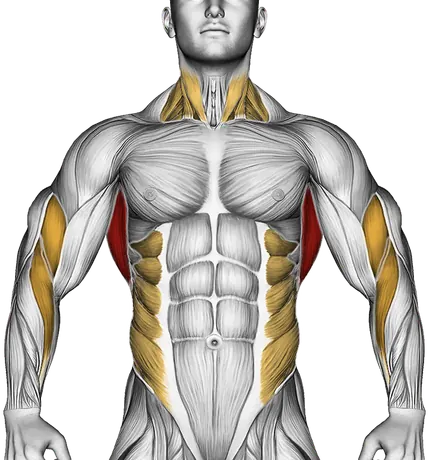 Front
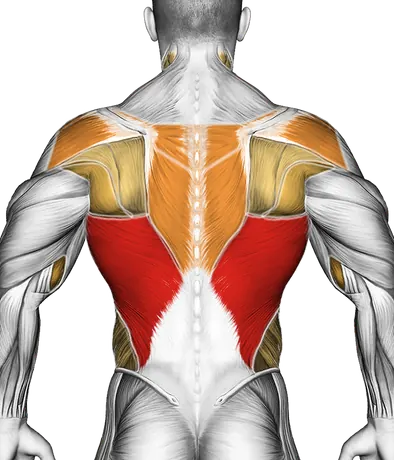 Back
- Latissimus100%
- Teres major25%
- Rear delts50%
- Middle traps50%
- Lower traps50%
- Brachialis33%
- Brachioradialis33%
On this page
Setup
- Adjust the thigh pad so your legs are locked in and you cannot lift off the seat.
- Stand, take the bar with a grip slightly wider than shoulder width, and sit down with it.
- Sit tall with your chest up and lean back about 10 to 20 degrees.
- Let your arms straighten fully and your shoulders rise — feel the stretch along your sides.
That top stretch matters. Many lifters start every rep with their shoulders already pulled down, which cuts off the part of the movement where the lats are longest and working hardest.
Pull with your elbows
Think about your elbows, not your hands. Drive the elbows down and slightly back toward your back pockets, and let the hands simply come along for the ride. That one change is the most reliable way to feel the lats rather than the biceps.
Pull until the bar is around your upper chest or collarbone, pause for a moment with your chest up, then control the bar back up for two to three seconds until your arms are straight and your shoulders stretched. The lowering phase is half the exercise — do not let the stack yank you up.
Common mistakes
- Thighs locked under the pad, slight lean back
- Full stretch at the top of every rep
- Elbows drive down toward the ribs
- Controlled two-to-three-second return
- Leaning far back and turning it into a row
- Swinging the torso to move the weight
- Pulling the bar behind the neck
- Cutting the stretch short to lift more
If you only feel your biceps and forearms, the weight is usually too heavy and you are pulling with your hands. Drop the load by a fifth, slow down and focus on the elbows. Lifting straps can also help by taking the grip out of the equation.
Grip options
| Wide overhand | Neutral close grip | |
|---|---|---|
| Feels like | Classic "width" pulldown | Stronger, shoulder-friendly |
| Range of motion | Shorter | Longer, deeper stretch |
| Load | Lighter | Heavier |
| Good for | Variety, upper-back involvement | Lat growth, sore shoulders |
Wide, neutral and underhand grips all train the lats well; research does not show one to be clearly superior. A shoulder-width neutral grip often allows the longest range and the heaviest loads, which makes it a great default. Rotate grips every training block if your joints like the variety. Single-arm pulldowns are excellent too — they let you stretch each side further.
Programming and progression
Use 3 to 4 sets of 8 to 15 reps, one to three reps from failure. The pulldown pairs well after pull-ups or rows on a pull day, or as the main vertical pull if pull-ups are not there yet.
Progress with double progression: add reps until you reach the top of the range on every set, then move the pin down one plate. If the jumps on the stack are big, a small add-on weight or an extra rep at the same load bridges the gap.
The pulldown is also the best tool for building up to bodyweight pull-ups — see how to get your first pull-up. For the complete back picture, read how to build a wider back.
- Lock your legs in, lean back only slightly and start from a full stretch.
- Drive your elbows down toward your ribs; let the hands follow.
- Pull to the upper chest and control the bar back up.
- If you only feel your biceps, lighten the load and slow down.
- All grips work; a neutral shoulder-width grip is a strong default.
Frequently asked questions
Should I pull behind the neck?
Usually no. Pulling to the upper chest trains the lats just as well and puts the shoulders in a safer position for most people.
Why do I only feel my biceps?
The weight is probably too heavy, or you are pulling with your hands. Lighten it, think about driving your elbows down, and try lifting straps.
Can lat pulldowns help me do pull-ups?
Yes. They build the same muscles and vertical pulling strength. You still need some pull-up practice to learn the skill of moving your body.
How far should I lean back?
About 10 to 20 degrees — just enough for the bar to clear your face. Leaning much further turns the exercise into a row.
Wide grip or close grip for a wider back?
Both build the lats. Grip changes the feel more than the result, so choose the one you can pull through the fullest range with good control.
Related guides
Pull-Ups and Rows: How to Build a Strong Back
How to do pull-ups and rows with proper form: grip, scapular control, full range of motion, and the mistakes that turn back exercises into arm exercises.
Beginner · 4 min read
How to Get Your First Pull-Up
How to get your first pull-up: the exercises that build it, a week-by-week progression with assisted pull-ups and negatives, and how to test and keep improving.
Beginner · 4 min read
How to Build a Wider, Thicker Back
How to build a bigger back: training for width and thickness, the best vertical and horizontal pulling exercises, ideal volume, and common mistakes.
Intermediate · 3 min read
Barbell Row Form: Build a Stronger Back
Barbell row form, step by step: setup, torso angle, bar path, grip, common mistakes, and how to program bent-over rows for a thicker, stronger back.
Intermediate · 4 min read
This guide is general educational information, not medical advice. Train within your ability and consult a qualified professional before starting a new program if you have an injury or health condition.