
Lifting Technique · Beginner · 4 min read
Dumbbell Press Form: Chest and Shoulder Technique
Dumbbell presses are among the best chest and shoulder builders there are. Each arm moves freely, the range can be deeper than a barbell allows, and imbalances between sides have nowhere to hide. That freedom only helps if you control it — starting with getting the dumbbells into position safely.
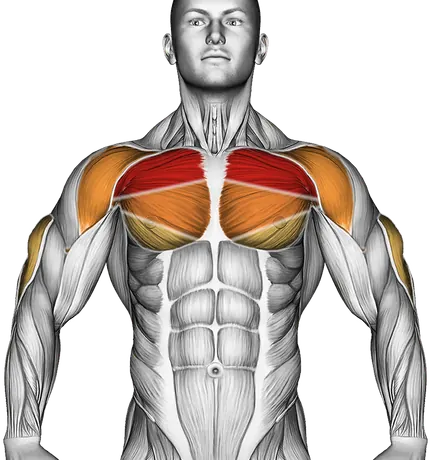 Front
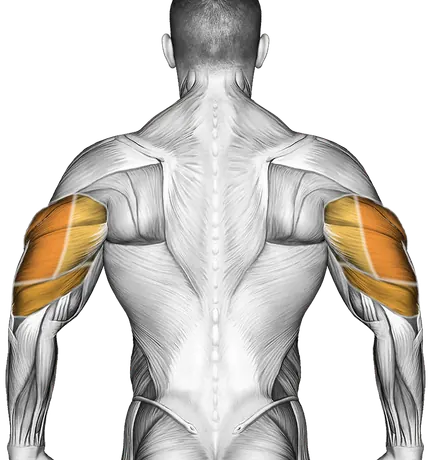 Back
- Upper chest100%
- Middle chest56%
- Front delts50%
- Triceps lateral head50%
- Triceps medial head39%
On this page
Getting into position
With heavy dumbbells, the setup is often harder than the set. The knee kick makes it easy:
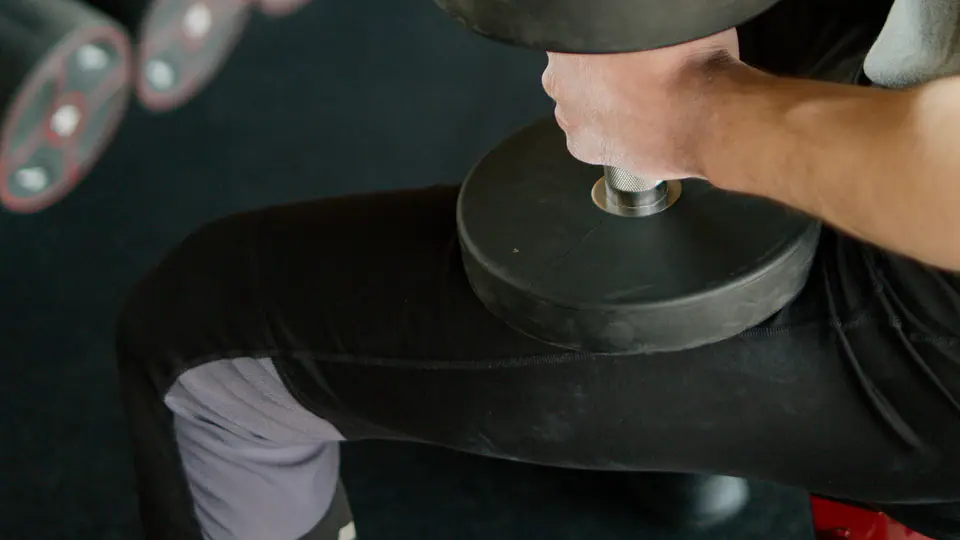
- Sit on the end of the bench with the dumbbells standing on your thighs, near your knees.
- Hold them tight and lie back in one smooth motion, bringing your knees up as you go.
- Let your knees push the dumbbells up so they arrive over your chest, arms nearly straight.
- Plant your feet flat, squeeze your shoulder blades together and down, and begin.
To finish, bring the dumbbells down to your chest, lift your knees to meet them, and use that momentum to sit up. Never just drop heavy dumbbells out to your sides from the top.
The press
Lower both dumbbells together, with your elbows about 30 to 60 degrees from your torso — between tucked and flared. Let them descend until you feel a strong, controlled stretch across the chest; for most people the dumbbells end up level with or slightly below the chest. Pause briefly, then press up and slightly inward until your arms are straight over your shoulders.
The dumbbells do not need to touch at the top. Stopping them a few centimetres apart keeps tension on the chest and avoids the jolt that throws off your next rep.
Common mistakes
- Shoulder blades pulled back and down, chest up
- Elbows at a natural 30 to 60 degrees
- Deep, controlled stretch at the bottom
- Feet planted, butt on the bench
- Elbows flared straight out at 90 degrees
- Bouncing out of the bottom
- Cutting the range short to lift heavier dumbbells
- Dropping heavy dumbbells to the floor from the top
If the setup is harder than the working set, or you lose your shoulder position halfway through, the dumbbells are too heavy. Go down a pair and own the range.
Flat vs incline
| Flat press | Incline press | |
|---|---|---|
| Bench angle | Flat | 15 to 30 degrees |
| More emphasis on | Mid and lower chest | Upper chest and front delts |
| Typical load | Heavier | About 10 to 20 percent lighter |
| Good for | Overall chest mass | Filling out the upper chest |
A low incline of 15 to 30 degrees targets the upper chest well. Steeper angles shift the work increasingly to the front delts, turning it into a shoulder press. Most programs benefit from both angles across the week. For the barbell version, see bench press form and incline bench press form.
Programming and progression
Use 3 to 4 sets of 6 to 12 reps, one to three reps from failure. Dumbbell presses work well as the main press on a chest day, or as a second press after the barbell bench.
Progress with double progression. Because dumbbells usually jump 2 to 2.5 kg per hand — often a 10 percent jump or more — use reps first: work up to 12 clean reps before moving up and dropping back to 8. A slower three-second lowering phase is another way to make the same pair harder.
For how dumbbell pressing fits a full chest plan, read how to build a bigger chest.
- Use the knee kick to get heavy dumbbells into position safely.
- Keep elbows at 30 to 60 degrees — not tucked tight, not fully flared.
- Lower to a deep, controlled chest stretch; do not bounce.
- Low incline (15 to 30 degrees) targets the upper chest.
- Progress with reps first, because dumbbell jumps are big.
Frequently asked questions
Are dumbbell presses better than barbell bench?
Neither is better — they are different. Dumbbells offer freer movement and a deeper stretch; a barbell allows heavier loads and smaller progression steps. Most programs use both.
How low should I go?
Until you feel a strong, controlled chest stretch without shoulder pain or losing your shoulder-blade position — usually with the dumbbells level with or slightly below the chest.
Why do my shoulders hurt on dumbbell press?
Common causes are elbows flared to 90 degrees, a weight that is too heavy, a range deeper than you can control yet, or an incline set too steep. Adjust those before stopping the exercise.
Should the dumbbells touch at the top?
No need. Stopping a few centimetres apart keeps tension on the chest and prevents the clang that throws off your next rep.
How do I get heavy dumbbells into position?
Use the knee kick: dumbbells on your thighs, lie back and drive your knees up to lift them over your chest. Reverse it to sit up at the end of the set.
Related guides
Bench Press Form: How to Bench Press Properly
How to bench press with proper form: grip, arch, bar path, leg drive and the common mistakes. A step-by-step guide to a safe, stronger bench.
Beginner · 4 min read
How to Build a Bigger Chest
How to build a bigger chest: the best chest exercises, training all areas of the pecs, ideal volume and reps, and the mistakes that stall chest growth.
Beginner · 3 min read
How to Build Bigger Shoulders
How to build bigger shoulders: train all three delt heads, the best exercises for width, how many sets and reps, and the lateral raise mistakes to avoid.
Intermediate · 4 min read
Free Weights vs Machines: Which Is Better?
Free weights vs machines for building muscle and strength — the real pros and cons, what the research says, and how to use both for the best results.
Beginner · 3 min read
This guide is general educational information, not medical advice. Train within your ability and consult a qualified professional before starting a new program if you have an injury or health condition.