
Lifting Technique · Beginner · 4 min read
Lunge Form: How to Train Legs Without Knee Pain
Lunges build the quads and glutes, fix left-right imbalances and train the balance and control that two-legged lifts never ask for. They also expose every weak link quickly — which is exactly why a good setup and a stable stride matter so much.
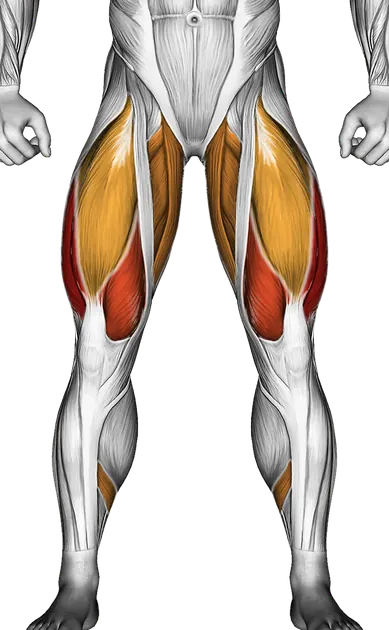 Front
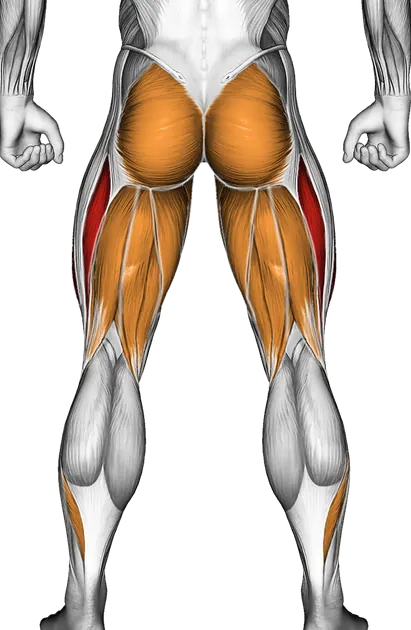 Back
- Vastus lateralis100%
- Vastus medialis82%
- Rectus femoris40%
- Gluteus maximus50%
- Adductors50%
- Biceps femoris50%
- Semitendinosus50%
- Soleus50%
On this page
Basic technique
- Stand tall, feet hip-width apart, hands on hips or holding dumbbells.
- Step one foot back far enough that both knees can bend to about 90 degrees.
- Lower straight down with control, weight mostly on the front foot.
- Stop just before the back knee touches the floor.
- Drive through the front heel and mid-foot to return to standing.
- Finish all reps on one side, then switch.
The reverse lunge is the best starting point: stepping back is easier to balance and puts less shear on the front knee than stepping forward.
Stride and torso: quads or glutes
| Short stride, upright torso | Long stride, slight lean | |
|---|---|---|
| Front knee | Travels forward over the toes | Stays roughly over the ankle |
| Main target | Quads | Glutes and adductors |
| Feels like | A single-leg squat | A single-leg hip hinge |
| Good for | Quad growth, knee strength | Glute growth, hip strength |
Both are valid. Pick the version that matches your goal and keep it consistent within a set. And yes — the front knee is allowed to go past your toes if it is controlled and pain-free. Forcing it back only shifts stress to the hips and lower back.
Common mistakes
- Front heel stays planted the whole rep
- Front knee tracks in line with the toes
- Weight mostly on the front leg
- Controlled lowering, no bouncing the back knee
- Knee collapsing inward on the way up
- Pushing mostly off the back leg
- A stance so narrow you wobble like a tightrope walker
- Rushing reps until balance becomes the limit
Balance is the most common problem. Widen your stance so your feet are on two separate "train tracks" rather than one line, and hold something for support with one hand if you need to. Support is not cheating — it lets your legs, not your balance, decide when the set ends.
Variations
- Reverse lunge: the most beginner-friendly and knee-friendly.
- Walking lunge: adds rhythm and conditioning; great for high reps.
- Forward lunge: harder on balance and deceleration; useful for athletes.
- Bulgarian split squat: rear foot on a bench — the hardest and one of the best for growth. See Bulgarian split squat form.
- Deficit reverse lunge: front foot on a low step for a deeper stretch in the glutes and quads.
Holding dumbbells at your sides is the simplest way to load lunges. A barbell on your back allows more weight but makes balance harder; a single dumbbell held on the side of the working leg adds a core challenge.
Lunges without knee pain
Lunges are not bad for knees, but a few changes make them far more comfortable if yours are sensitive:
- Switch from forward to reverse lunges.
- Shorten the range — stop a few centimetres higher — and build depth over weeks.
- Slow the lowering to three seconds; control is kinder to joints than speed.
- Use a slightly longer stride so the front shin stays more vertical.
Pain that is sharp, or that worsens week to week, is a signal to change the exercise and get it checked. Programming-wise, use 2 to 4 sets of 8 to 15 reps per leg, after your main squat or leg press. See how to build bigger legs for how lunges fit a full leg day.
- Keep the front heel planted and the front knee tracking over the toes.
- A short stride works the quads more; a long stride works the glutes more.
- Reverse lunges are the most beginner- and knee-friendly version.
- Use a wider stance or hold support if balance is limiting the set.
- Program 2 to 4 sets of 8 to 15 reps per leg after your main leg lift.
Frequently asked questions
Are lunges bad for knees?
No. Knee pain usually comes from poor control, too much load too soon, or a variation that does not suit you. Reverse lunges, a shorter range and a slower tempo help most people.
Should my knee go past my toes?
It can, if it is controlled and pain-free. Knees travelling forward is normal in lunges and squats; forcing them back just moves the stress elsewhere.
Which lunge is best for glutes?
Long-stride reverse lunges, deficit reverse lunges and Bulgarian split squats with a slight forward lean emphasise the glutes well.
Should I alternate legs or do one side at a time?
One side at a time is better for building strength and muscle, because the working leg does not get a rest between reps. Alternating suits walking lunges and conditioning.
Lunges or squats?
Both. Squats let you load heavier; lunges add single-leg strength, balance and hip stability. Most good leg programs use both.
Related guides
How to Build Bigger Legs
How to build bigger legs: training quads, hamstrings and calves, the best leg exercises, why you should not skip leg day, and how to progress.
Intermediate · 3 min read
How to Build Bigger Glutes
How to build bigger, stronger glutes: the best glute exercises, why hip thrusts and squats matter, ideal volume and progression, and common mistakes.
Intermediate · 3 min read
Leg Press Form: Quads, Glutes and Safe Depth
Leg press form, step by step: seat and foot placement, how deep to go, knee tracking, lower-back safety, and how to build bigger quads and glutes.
Beginner · 4 min read
Squat Form: How to Squat With Proper Technique
How to squat with proper form: setup, bracing, depth, knees and common mistakes. A step-by-step guide to a safe, strong barbell back squat.
Beginner · 5 min read
This guide is general educational information, not medical advice. Train within your ability and consult a qualified professional before starting a new program if you have an injury or health condition.